Surviving the Age of AI as a Security Research Analyst
If you are not using AI aggressively, people assume you are inefficient.
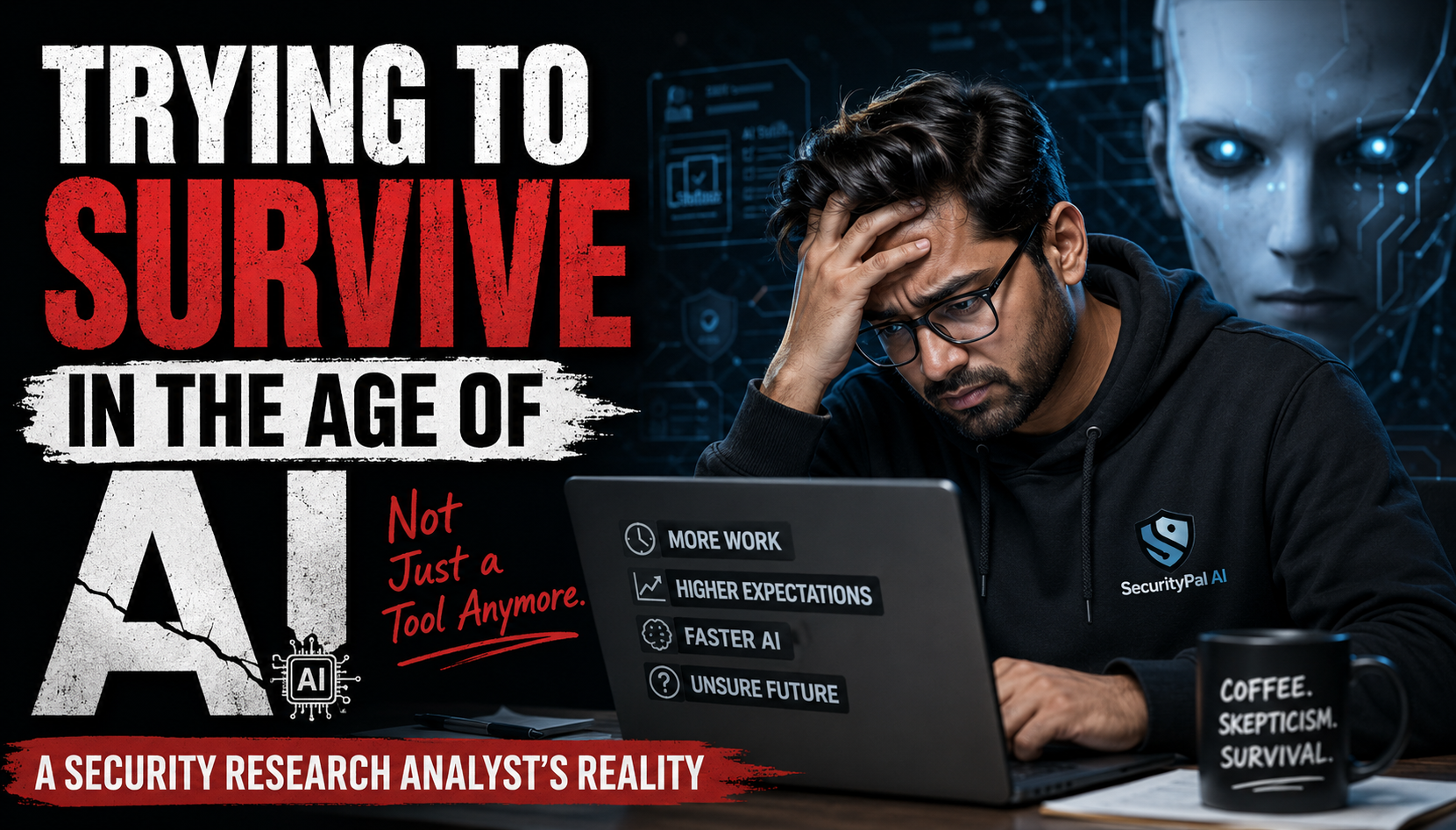
Everyone keeps saying AI will “augment” jobs.
That word sounds comforting. Corporate. Safe.
But if you work in knowledge work — especially in cybersecurity, compliance, or security operations — you know the truth feels very different.
AI is not politely augmenting us.
It is circling us.
I work as a Security Research Analyst at SecurityPal, and every few months I feel like the definition of my role changes again. Not because leadership changed strategy. Not because customers changed. But because AI keeps getting better at the exact tasks I spent years becoming good at.
And that is a terrifying thing to quietly experience every day.
The uncomfortable truth nobody wants to say
A large part of modern corporate work is pattern recognition.
Security questionnaires.
Vendor assessments.
RFPs.
Policy mapping.
Evidence analysis.
Compliance translation.
Control alignment.
For years, humans like me built careers on knowing how to:
interpret vague security questions,
map answers to frameworks,
identify gaps,
communicate risk professionally,
and translate technical concepts into business language.
Then AI showed up and did 70% of it in seconds.
Not perfectly.
But disturbingly well.
And that changes you psychologically.
Because suddenly the thing you thought made you valuable becomes automatable.
The weird emotional state of working with AI
People imagine AI fear as dramatic panic:
“The robots are taking over!”
In reality, it is quieter than that.
It looks like:
opening ChatGPT before your own brain starts thinking,
feeling slower than the model,
rewriting AI-generated answers instead of creating from scratch,
wondering whether your experience still matters,
questioning if junior analysts will even need the same learning curve anymore.
Sometimes I catch myself doing something dangerous:
I stop thinking deeply because AI already gave me a “good enough” answer.
That scares me more than job loss.
Because once critical thinking weakens, recovery is hard.
Security work is changing faster than security people admit
Cybersecurity people love talking about attackers using AI.
But we rarely talk about how defensive and governance roles are quietly being transformed internally.
The modern security analyst is no longer just:
a researcher,
a compliance mapper,
or a documentation expert.
Now you must become:
an AI validator,
an AI editor,
an AI prompt engineer,
an AI risk reviewer,
and sometimes an AI babysitter.
The work shifted from:
“Can you create this?”
to:
“Can you verify this AI output is actually correct?”
That sounds easier.
It is not.
Because bad AI output is often convincingly wrong.
And in security, “almost correct” can become:
legal exposure,
failed audits,
compliance gaps,
customer distrust,
or contractual risk.
So now my value increasingly comes from skepticism.
Not speed.
AI rewards shallow confidence
One thing I have noticed online is that AI created an entire economy of fake expertise.
People who barely understand:
SOC 2,
ISO 27001,
cloud security,
IAM,
or vulnerability management
can now generate polished-looking explanations instantly.
And honestly?
Sometimes management cannot tell the difference.
That is dangerous.
Because cybersecurity is one of those fields where surface-level understanding creates invisible failures.
You can sound extremely intelligent while being catastrophically wrong.
AI amplifies that problem.
The pressure to become “AI-native”
There is also social pressure now.
If you are not using AI aggressively, people assume you are inefficient.
So everyone starts optimizing for:
faster outputs,
more automation,
more generated content,
more productivity metrics.
But very few people ask:
“Are we still understanding the work deeply?”
I worry that we are creating analysts who can produce answers without building foundational reasoning.
That becomes a long-term industry problem.
Because eventually someone must still understand:
why a control matters,
how systems actually fail,
what risk really means,
and where AI hallucinated compliance nonsense.
My personal survival strategy
I do not think competing against AI is realistic anymore.
The people saying “AI will never replace humans” sound increasingly disconnected from reality.
Instead, I think survival depends on becoming difficult to commoditize.
For me, that means:
building stronger judgment,
improving communication,
understanding business context,
learning deeper security concepts,
and becoming exceptionally good at spotting errors and inconsistencies.
AI is good at generating.
Humans still matter in:
accountability,
trust,
prioritization,
nuance,
and critical decision-making.
At least for now.
The hardest realization
The hardest realization is this:
Your value is no longer tied to how hard your skills were to learn.
That old equation broke.
You may have spent years mastering something AI learned statistically in months.
The market does not care how long it took you.
That hurts to admit.
But ignoring it is worse.
Final thoughts
I am not anti-AI.
I use AI every single day.
It genuinely makes me better at my work when used correctly.
But I also think many professionals are emotionally underestimating what is happening.
We are living through a period where:
expertise is being compressed,
entry barriers are collapsing,
and entire career paths are being reshaped in real time.
Some people will adapt.
Some will deny reality until it is too late.
I am trying to do neither.
I am trying to survive intelligently.
And honestly, some days even that feels uncertain.
Ready to test your understanding?
Turn this article into active practice.
Apply the idea in a short ISO 27001 quiz.
Take quick quiz